


The gap before the gaps
The policy and research fields often express concern over data, evidence, and funding gaps. Comparatively little attention is paid to the gap that arguably comes first: who gets to ask questions and set agendas that determine what (and what types of) data and evidence get produced.
Public policy, clinical trials, and other forms of research all exist downstream from choices about what is worth asking and investigating. The ability to define agendas and ask questions is a form of power. It is also inherently political—a reflection and perpetuation of existing power asymmetries. Questions decide what is measured, who is counted, which outcomes matter, and what is an acceptable answer. In fact, by the time a funder issues a call or a researcher designs a protocol, most of the consequential choices have already been made. To understand how agendas are set and why entire dimensions of knowledge and knowledge production are neglected, we need to talk about equity and inequity in questioning. We need to examine the distribution of power to pose, frame, prioritize, and resource questions, especially among people who are most affected by the answers.
This essay focuses on the different forms of power and exclusion that are central to the questions process. In subsequent pieces, we will examine the downstream effects of power on the evidence that gets produced, and explore possible responses.
Questions as a form of power
Deciding what gets asked is an often quiet but decisive form of agenda-setting. It rarely looks like an exercise of power, because it happens in grant calls, review criteria, survey instruments, and in the unstated assumptions of whoever is in the room. But the ability to decide what questions get asked often has powerful downstream implications.
The ability to determine agendas can be seen as a form of power to include and exclude certain individuals, communities, and worldviews. Philosophy gives us language for this. Miranda Fricker’s work on epistemic injustice describes wrongs done to people specifically in their capacity as knowers. Testimonial injustice occurs when someone’s account is given less credibility because of who they are. Hermeneutical injustice occurs when a gap in shared concepts leaves people unable to make sense of, or communicate, their own experience. Both operate upstream of research: the first form of injustice discounts the person raising a question, the second means their question cannot be fully formed (at least in terms and language that get acknowledged).
The health research community has also documented how wrong questions can result in various forms of invisibility. Chalmers and Glasziou estimated that the large majority of investment in biomedical research is wasted because the questions being asked do not matter to patients and clinicians. The UK’s James Lind Alliance was created in 2004 precisely because researchers’ agendas and patients’ needs had been shown to diverge.
The four layers of inequity
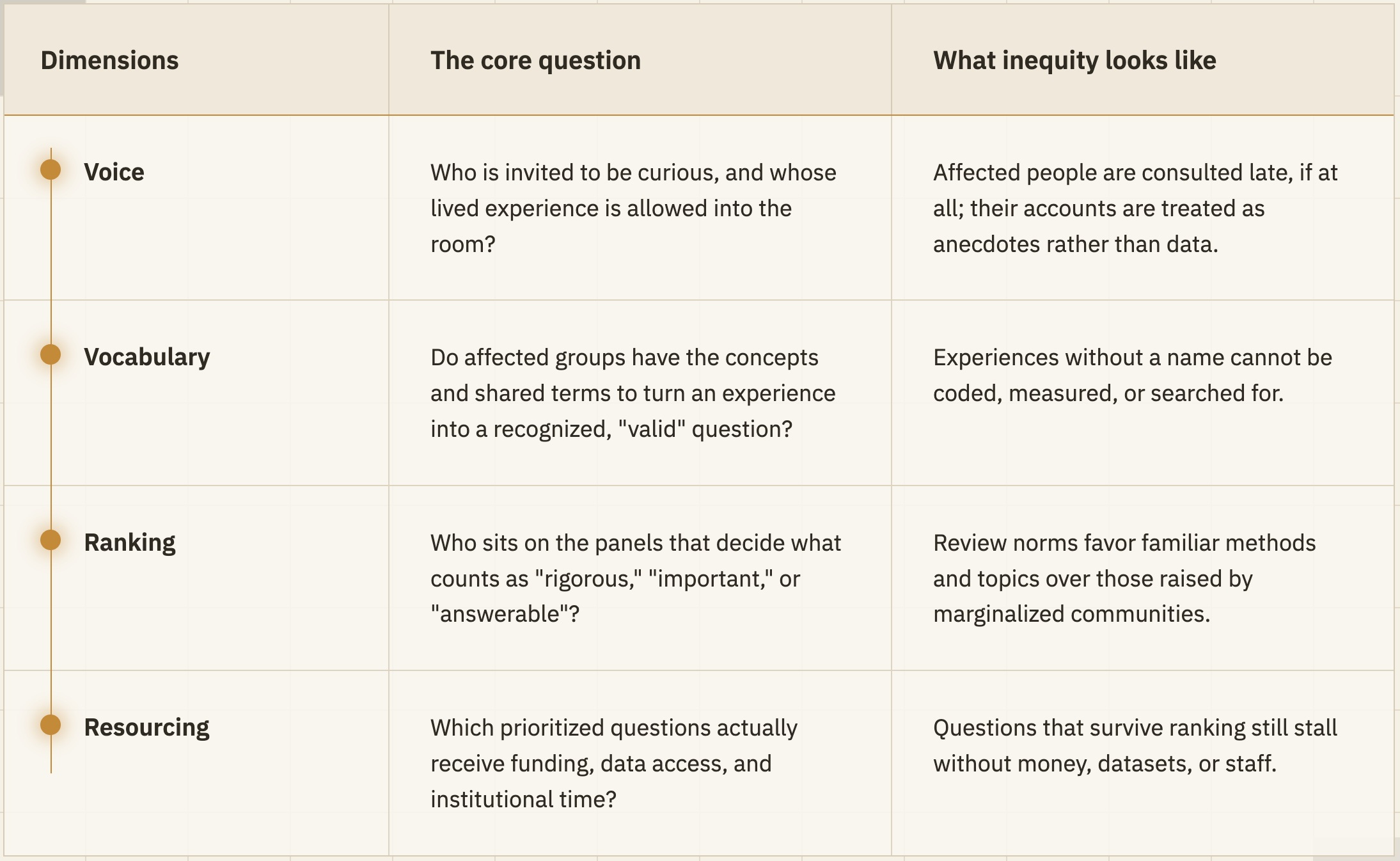
How does power in questioning get exercised, and why does it matter? When question-setting is controlled by a small set of actors, equity breaks down across four distinct dimensions, each with its distinct implications.
Voice
The voice layer refers to who is invited to be curious—i.e., to set questions. Those with lived experience and most impacted by research, such as patients, carers, and frontline workers, have rarely contributed to setting research agendas. Crowe and colleagues name this as the most obvious explanation for the mismatch they documented between patients and researchers: some questions that matter to patients may simply never occur to researchers in the first place. They point, for example, to a James Lind Alliance exercise in which patients, carers, and clinicians identified breathing exercises as an important unanswered question in asthma treatment, one researchers had largely overlooked. A clinical trial was subsequently funded to investigate it.
Voice is also shaped by testimonial injustice. For example, women are more likely to have symptoms dismissed or misdiagnosed as psychological causes, and conditions that disproportionately affect them (e.g., endometriosis, menopause) remain comparatively under-researched. When patients’ accounts are not treated as credible evidence of a problem, their experiences are less likely to be translated into research questions in the first place.
Vocabulary
A question needs words before it can be asked. Fricker’s key example of hermeneutical injustice is the term, “sexual harassment.” Before the term was coined in the 1970s, women who experienced it lacked a shared concept to make sense of it or even explain it to others. Once the term existed, it could be surveyed, litigated, and studied.
The same dynamic runs throughout research. Conditions without agreed definitions, diagnostic codes, or outcome measures are hard to turn into fundable questions. Even “women’s health” has no universally accepted definition, which is why the 100 Questions Initiative (discussed further below) began by building a topic map of the field. Such topic maps, built in a participative and inclusive way, can be a valuable way of mapping out the issues and questions that truly matter–as well as those whose voices should be heard on the issues.
Ranking
Rankings play a central (if often under-appreciated) role in setting research agendas. Rankings are where institutional judgments about what is important determine the projects that go forward. An NIH analysis of research grant applications from 2011 to 2015 found that Black scientists were more likely to propose community- and population-level research, topics that received awards at lower rates than fundamental and mechanistic work. Topic choice alone accounted for over 20% of the funding gap between Black and white applicants. Health disparities research and patient-focused interventions were among the topics with the lowest success rates, for white applicants too.
Method preferences matter as well. Crowe and colleagues point to “methodological disincentives”: drug trials are usually simpler to design and interpret than trials of psychological therapies, physical therapies, or service delivery. What is easy to answer tends to be ranked as more likely to be ranked first.
Resourcing
Resourcing—in the form of funding as well as staffing, access to data or compute and other factors—plays a central role in deciding what questions become studies. A question may be recognized as important and even survive institutional selection, yet still go unanswered because the resources required to investigate it are directed elsewhere. This creates another source of inequity. Some questions are simply more expensive to pursue than others. Some may depend on datasets or populations that researchers cannot easily access. As a result, research agendas can be shaped not only by what is considered important, but by what institutions have the capacity and incentives to study.
Here, burden and funding often diverge. Analyzing NIH funding against disease burden, Mirin found that in nearly three-quarters of diseases that mainly affect one gender, the funding pattern favors males. The broader point is that even when a need is visible, visibility does not guarantee resources. Questions without money, data, or personnel often remain questions rather than translating into evidence.
How the dimensions compound
The inequities described above are compounded by the fact that the four layers are not independent. They form a self-reinforcing cycle in which absence of evidence becomes the justification for continued absence. Thus, exclusion at one stage can make exclusion at the next more likely, ultimately reproducing the very evidence gaps that then appear to justify the original neglect.
Silenced voice. A group is rarely asked for input, so its experiences stay private and unrecorded. The voice of certain groups essentially remains unheard.
Missing vocabulary. Without a forum in which its experiences can be shared, the group never develops shared terms, definitions, or measures for what it experiences. Relevant questions are simply not articulated, at least in ways that are legible to grants committees and others with power to set agendas.
Low ranking. Questions that arrive poorly framed, or framed in unfamiliar terms, may fare worse when institutions assess their importance, rigor, and feasibility, making them less likely to move forward.
No resources. Questions that are not selected as priorities are less likely to receive funding, data access, staff, or other forms of institutional support; the studies and datasets needed to answer these questions never get produced.
Absent evidence. The resulting evidence gap can then be read as a sign that the issue is minor or intractable, making the group less likely to be consulted in the future. The cycle of powerlessness restarts.
One important consequence of this self-reinforcing cycle is that funding alone cannot solve the various forms of inequity. If the upstream processes that determine which questions are recognized remain unchanged, additional resources are likely to flow toward the same kinds of questions. Closing evidence gaps therefore requires attention not only to how much money is available but, more fundamentally, to who gets to shape the questions that enter the pipeline in the first place.
In later posts, we will examine some of the specific ways in which these forms of power manifest: the research they produce (and fail to produce), the priorities they elevate, and the evidence gaps that emerge as a result. We will also examine potential responses, including efforts to redistribute question-setting power through initiatives such as The GovLab’s 100 Questions Initiative.
Grateful for the editorial and research support of Ruby Rogers, Hannah Chafetz and Akash Kapur